
Strategic Workforce Planning has become a critical management discipline in a volatile environment: it is shaped by rapid technological change, increasing skill scarcity, and growing uncertainty about future workforce needs. Business strategies are evolving faster than traditional planning cycles and workforce decisions increasingly determine whether strategic ambitions can be realized or not.
Yet many organizations still struggle to move beyond fragmented, reactive workforce initiatives. Strategic Workforce Planning is often reduced to a quantitative headcount exercise or confused with workforce analytics or skills management initiatives. As a result, workforce insights remain disconnected from strategic decision-making.
In reality, effective Strategic Workforce Planning is neither a one-off analysis nor an isolated HR activity. It is a continuous, end-to-end management process that translates business strategy into concrete workforce decisions and ensures long-term organizational capability.
This article outlines a structured approach to Strategic Workforce Planning—from strategic intent to execution and monitoring.
Strategic Workforce Planning versus Workforce Analytics
Before examining the process in detail, it is important to distinguish Strategic Workforce Planning from workforce analytics.
Workforce analytics (or people analytics) focuses on identifying patterns and relationships between workforce data and business outcomes, such as performance, engagement, retention, or productivity. Its strength lies in explanation and prediction.
Strategic Workforce Planning, by contrast, is decision-oriented and explicitly forward-looking. Its purpose is not to generate insight, but to enable leadership to make informed decisions about future workforce capacity and capabilities over a multi-year horizon.
Analytics and skills data are essential enablers of Strategic Workforce Planning. But without a structured planning logic and execution model, even the most sophisticated analyses remain operationally inconsequential.
Strategic Workforce Planning as a Six-Step Process
Effective Strategic Workforce Planning follows a structured, repeatable process that connects strategy to execution. While organizations differ in maturity, the underlying logic remains consistent.
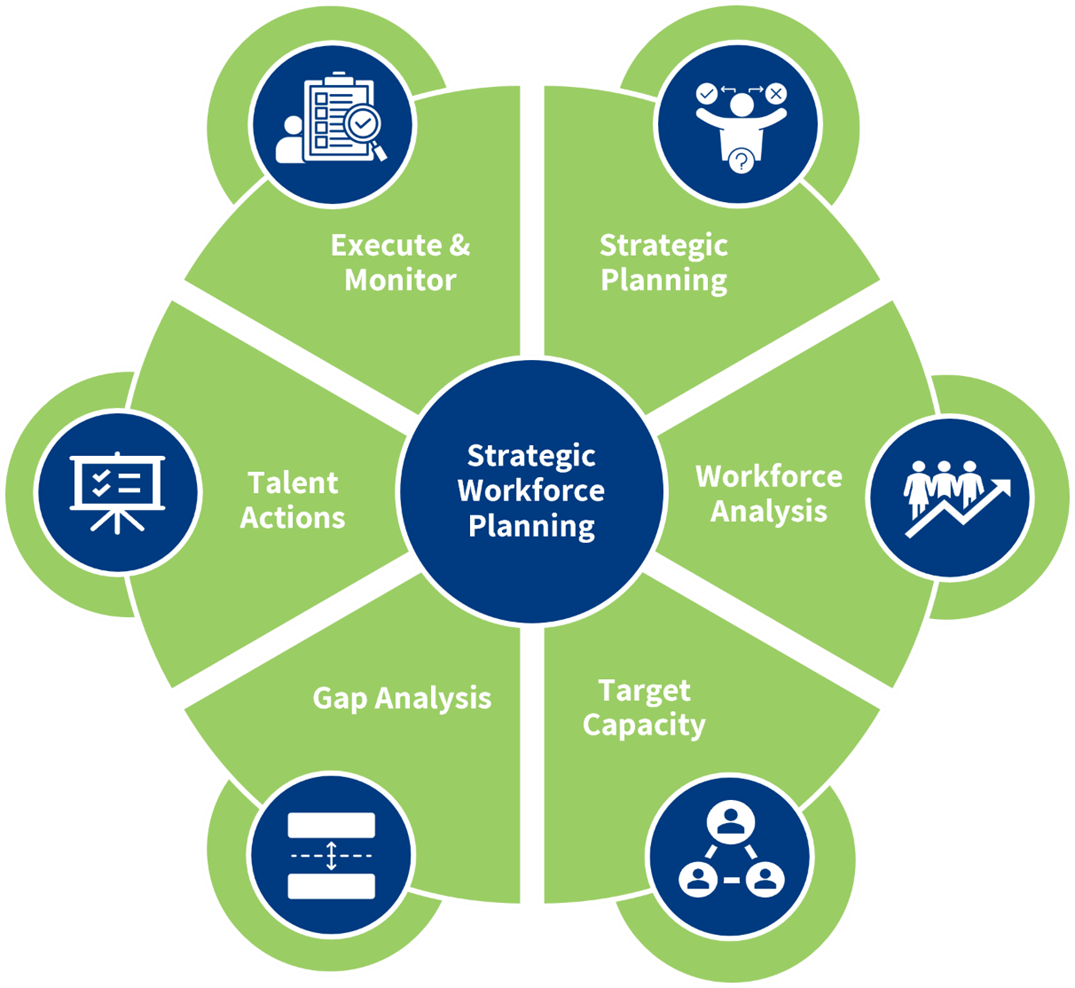
1. Strategic Planning: Anchoring Workforce Strategy in Business Strategy
Strategic Workforce Planning starts with a clear understanding of the organization’s business strategy and transformation priorities. Growth ambitions, operating model changes, technology investments, geographic shifts, and cost targets all have direct implications for workforce requirements. At this stage, the focus is not yet on headcount or specific roles, but on understanding how the organization intends to create value in the future and what this means for the workforce at a strategic level.
At this stage, the central questions are:
- Which strategic priorities and transformation initiatives will shape the organization over the coming years?
- How will the business model, value creation logic, and ways of working evolve as a result of these priorities?
- What high-level workforce implications emerge from the strategy (e.g. build vs. buy, global vs. local, automation vs. human work)?
- Where could workforce-related constraints become a limiting factor for strategic execution?
Ownership of this step extends beyond HR. Strategic Planning requires close collaboration between business leaders, HR, and finance to ensure workforce implications are considered alongside financial and operational decisions.
2. Workforce Analysis: Understanding Existing and Future Workforce Dynamics
The Workforce Analysis establishes transparency about both the current workforce and its expected development over time, if no corrective actions are taken. It therefore combines a descriptive analysis of today’s workforce with a forward-looking projection of how this workforce is likely to evolve.
Key dimensions typically include:
- Workforce size and structure by jobs, job families, locations, and cost
- Demographic patterns and workforce dynamics such as age distribution, tenure and gender
- Historical and predictive indicators such as attrition, retirement risk, absence rates and promotion flows
- Existing skills and capability profiles, including proficiency levels where available
Using historical data and predictive assumptions (for example regarding fluctuation, retirements, or internal movements), organizations model a “do-nothing” scenario that shows how workforce capacity and capabilities are expected to develop over the planning horizon if no interventions occur.
Increasingly, skills data plays a central role in this step by moving the analysis beyond static job titles and enabling a more realistic assessment of current and future capability levels. As outlined in our article on Skills Management and Strategic Workforce Planning, skills transparency is critical to understanding not only what the workforce looks like today, but how it is likely to look like tomorrow.
The objective of the Workforce Analysis is not analytical perfection, but strategic relevance: creating a shared, data-based view of the current workforce and its projected evolution.
3. Target Capacity: Defining the Planned Future Workforce
In the Target Capacity step, strategic objectives are translated into a planned future workforce. This step defines what the organization needs in order to successfully execute its strategy, independent of how the current workforce is expected to evolve.
Rather than producing a single forecast, organizations typically define target states under different strategic and market scenarios. The Target Capacity may be expressed in terms of:
- Jobs and critical roles
- Required skills and proficiency levels
- Workforce volumes by location and time horizon
- Capacity assumptions influenced by automation, outsourcing, or internal mobility
This step translates the organization’s strategic priorities into concrete workforce requirements.
4. Gap Analysis: Identifying Gaps Between Forecasted Supply and Planned Demand
The Gap Analysis compares the forecasted workforce supply derived from the Workforce Analysis with the planned workforce demand defined in the Target Capacity.
Rather than comparing today’s workforce with a future target, this step explicitly focuses on the delta between where the workforce is expected to end up without any intervention and where it needs to be, according to the target capacity.
Gaps may be:
- Quantitative, such as shortages or surpluses in specific roles or locations
- Qualitative, such as missing or insufficient skills and proficiency levels
By integrating job-based and skills-based perspectives, organizations can distinguish between gaps that require external hiring and those that can be addressed through automation, reskilling, redeployment, or role redesign.
The Gap Analysis represents a critical decision point: it translates projections and targets into clear priorities and makes workforce-related risks visible and actionable.
5. Talent Actions: Closing the Gaps
Based on the identified gaps, organizations define targeted Talent Actions to steer the workforce from the forecasted state toward the planned target state.
Typical actions include:
- Reskilling and upskilling existing employees
- Internal mobility and redeployment
- Targeted hiring or temporary staffing
- Automation
- Selective workforce reductions
Effective Strategic Workforce Planning does not attempt to address all gaps simultaneously. Instead, actions are prioritized based on strategic relevance, feasibility, cost, and time-to-impact. Skills Management plays a central role by enabling precise capability matching and individualized development pathways.
6. Execute and Monitor: From Planning to Continuous Steering
Strategic Workforce Planning only creates value when plans are executed and continuously monitored. This step transforms Strategic Workforce Planning, from a planning exercise into an ongoing steering mechanism.
Successful execution requires:
- Clear ownership and governance
- Integration with core HR processes such as recruiting, learning, performance management, and succession planning
- Transparent communication to leaders and employees
Progress is monitored using relevant KPIs such as workforce readiness, skill coverage, internal fill rates, time-to-skill, and strategic risk exposure. As assumptions and business conditions change, workforce plans are reviewed and adjusted accordingly.
Conclusion
Strategic Workforce Planning is most effective when understood as a holistic management process rather than a periodic HR exercise. By linking business strategy, workforce analysis and forecasting, future capacity planning, gap identification, targeted actions, and continuous monitoring, organizations can proactively shape their workforce instead of reacting to disruption.
In an environment where skills, roles, and business models evolve continuously, skills-enabled Strategic Workforce Planning is no longer optional. It is becoming the standard for an effective workforce strategy.
Written by: Elena Mayer