

Skillmanagement hat in den letzten Jahren stark an Aufmerksamkeit gewonnen, da immer mehr Entscheidungsträger das Thema auf dem Radar haben und es aktiv in ihren Organisationen vorantreiben. In der Begleitung unserer Kunden auf diesem Weg ist uns insbesondere eines aufgefallen: Die Nutzung von Skills in unterschiedlichen Formaten und Kontexten ist deutlich komplexer, als man zunächst vermuten würde, und erfordert eine vertiefte Auseinandersetzung.
So stellt sich beispielsweise häufig die Frage:
Reicht es aus, lediglich zwischen einer Mitarbeiter‑ und einer Organisationsperspektive auf Skills zu unterscheiden?
In diesem Blogbeitrag möchten wir eine differenziertere Sicht auf mögliche Perspektiven und relevante Skill‑Sets teilen. Aus unserer Erfahrung mit unterschiedlichen Kunden hat sich die folgende einfache Darstellung als besonders hilfreich für eine fundierte Diskussion erwiesen:
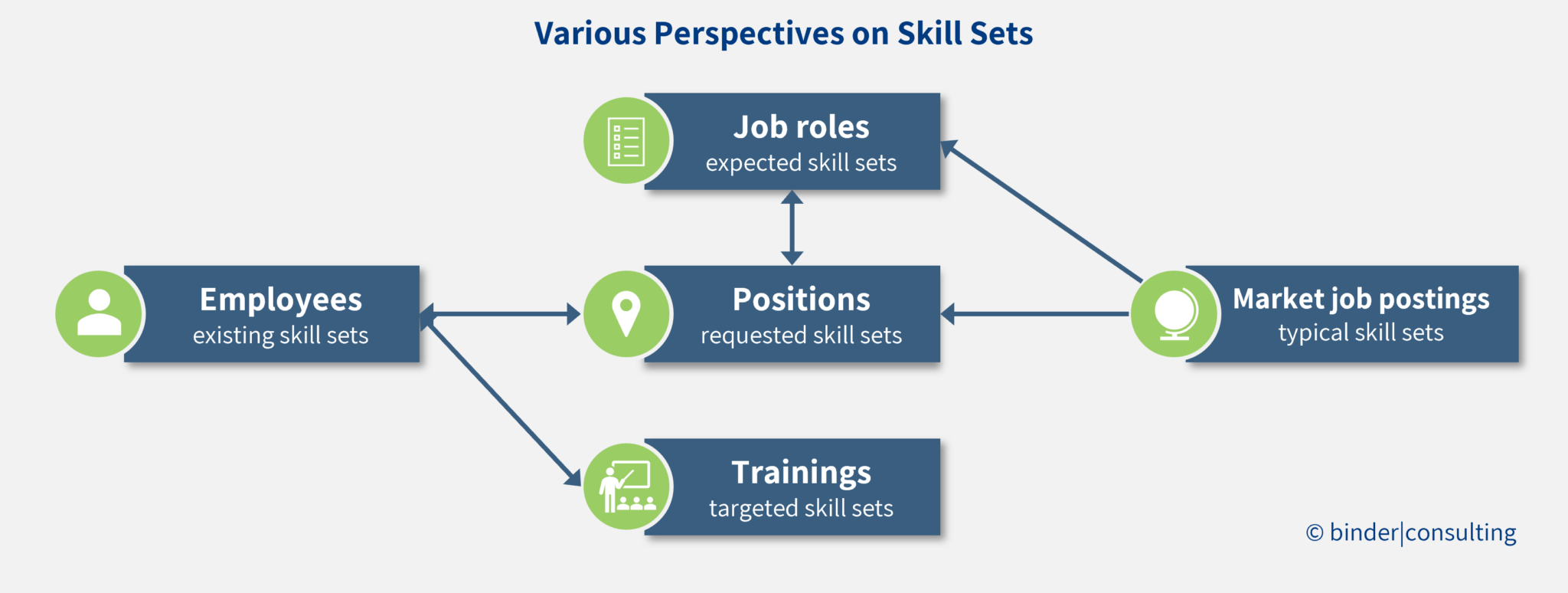
Unterschiedliche Perspektiven führen zu unterschiedlichen Skill‑Sets mit jeweils eigenen Use Cases, Mehrwerten und Aktualisierungszyklen.
Skill‑Sets von Mitarbeitenden
Jede Mitarbeiterin und jeder Mitarbeiter verfügt über ein individuelles Skill‑Set, das Fähigkeiten, Kompetenzen und Erfahrungen abbildet, die im Arbeitskontext relevant sind. In Kombination mit anderen Skill‑Sets bilden sie zudem die Grundlage für individualisiertes Lernen, die Gestaltung von Karrierepfaden sowie die Zuordnung von Mitarbeitenden zu (Projekt‑)Positionen.
Skill‑Sets von Jobrollen
Unternehmensspezifische Jobarchitekturen umfassen in der Regel mehrere hundert generische Jobrollen. Jede dieser Rollen kann durch ein Set erwarteter Skills beschrieben werden, über die eine Person in dieser Rolle verfügen sollte, um die anfallenden Aufgaben erfolgreich zu erfüllen.
Skill‑Sets von Positionen
Konkrete Positionen (und zugehörige Stellenausschreibungen) basieren häufig auf generischen Jobrollen. Die angeforderten Skill‑Sets sind jedoch meist spezifischer und vermitteln potenziellen Kandidatinnen und Kandidaten ein präzises Bild der Anforderungen einer vakanten Position.
Ein Abgleich der für eine Position erforderlichen Skills mit den Skills einer (potenziellen) Mitarbeiterin oder eines Mitarbeiters, der dieser Position zugeordnet ist oder sich darauf bewirbt, liefert Hinweise auf mögliche Skill‑Gaps. Diese Lücken können durch Trainings, optimierte Personaleinsatzplanung oder – falls erforderlich – durch Neueinstellungen geschlossen werden.
Skill‑Sets von Trainings
Unternehmen oder Trainingsanbieter sollten klar definieren, welches Ziel ein Training verfolgt: Welche Skills werden durch dieses Training adressiert? Die angestrebten Verbesserungen der Skills (inklusive Ausprägungsniveau) sollten mithilfe von künstlicher Intelligenz mit anderen Skill‑Sets verknüpft werden. So können passende Trainings gezielt ausgewählt werden, um Skill‑Gaps im Rahmen der Karriereentwicklung zu schließen.
Skill‑Sets aus Stellenausschreibungen (Marktperspektive)
Die kontinuierliche Analyse von Stellenausschreibungen – sowohl von direkten Wettbewerbern als auch global – ermöglicht es Unternehmen, Marktentwicklungen bei Skills im Zusammenhang mit angebotenen Jobs und Positionen zu verstehen. Der Abgleich dieser externen Anforderungen mit internen Skill‑Sets von Jobrollen und Positionen hilft dabei, unternehmensinterne Erwartungen marktgerecht zu halten und für neue Talente wie auch bestehende Mitarbeitende attraktiv zu bleiben.
Eine gemeinsame Skill‑Ontologie als zentrale Herausforderung
All diese Perspektiven auf Skill‑Sets unter einer unternehmensspezifischen Skill‑Ontologie zusammenzuführen und konsistent zu halten, ist eine große Herausforderung – aber eine notwendige Voraussetzung für durchgängiges Skillmanagement entlang des gesamten Employee Lifecycles.
Beispiel: Wie Skill‑Sets miteinander verknüpft sind
Anna arbeitet in ihrem Unternehmen als Mitarbeiterin im IT‑Helpdesk. Alle Mitglieder ihres Teams verfügen über bestimmte Skills, die sie für ihre Tätigkeit im IT‑Helpdesk benötigen. Diese Skills sind im Skill‑Set der entsprechenden Jobrolle beschrieben.
Da jede Mitarbeiterin und jeder Mitarbeiter Expertin bzw. Experte für unterschiedliche Kundenprobleme ist, verfügt jede konkrete Position über ein eigenes Skill‑Set, das die für die jeweilige Aufgabe erforderlichen Skills genauer beschreibt (z. B. Infrastruktur‑Support versus Applikations‑Support). Dies gilt auch für Annas Position.
Nach vier Jahren in ihrer Rolle möchte Anna sich beruflich weiterentwickeln. Wie viele ihrer Kolleginnen und Kollegen hat sie ein Skill‑Profil erstellt, in dem sie ihre Fähigkeiten beschreibt. Auf einem internen Talentmarktplatz entdeckt sie eine Position als Agile Coach, die sie interessiert. Die interne Stellenausschreibung listet die Skills auf, die für diese Rolle erforderlich sind.
Gemeinsam mit ihrer Führungskraft erstellt Anna einen Plan, um die noch fehlenden Skills über passende Trainings im Lernsystem aufzubauen. Einige Monate später bewirbt sie sich auf die Position – und erhält den Zuschlag.
Kurze Zusammenfassung dieses Blogbeitrags
Die Welt des Skillmanagements umfasst zahlreiche Kontexte und Logiken, die auf den ersten Blick schwer zu durchdringen sind. Um zu verstehen, wie Skills in einer Organisation genutzt werden können, ist es hilfreich, sie aus unterschiedlichen Perspektiven zu betrachten: Mitarbeitende, Positionen, Jobrollen, Trainings und Stellenausschreibungen.
Beispielhafte Anwendungsfälle wie der oben beschriebene helfen dabei, diese Zusammenhänge greifbar und verständlich zu machen.
Verfasst von: Paulina Liesenhoff, Verena Halmel