

In a fast-changing and highly competitive business environment, companies must constantly adapt their strategies. Carving out corporate or business units that are no longer strategically relevant can strengthen the overall market position and create significant value. However, successful portfolio adjustments require clear and well-defined processes as well as a deep understanding of interdependencies within the organization.
In large, global corporations, these interdependencies can quickly become complex - shared services, shared employees (“split-heads”), or shared production sites make accurate data on resources, contracts and finances surprisingly elusive. This creates risks such as underestimated timelines, resource gaps, or unexpected legal pitfalls.

It’s a bit like playing Mikado, one wrong move can set off a chain reaction. Being aware of dependencies upfront can be deal-critical!
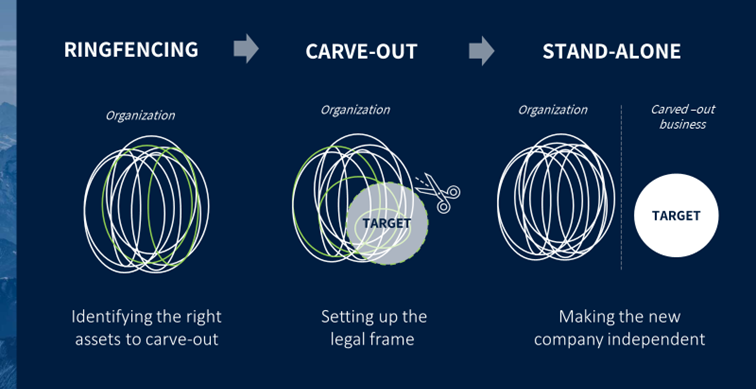
While every carve-out can vary in scope and complexity, three critical phases can be observed:
- Ring-fencing (or Baselining): Identifying the right assets and employees to be carved-out.
- Carve-out: Establishing the legal framework for the carved-out entity.
- Stand-alone: Enabling the new organization to operate independently.
Across all phases, one factor remains essential: people. The common assumption that HR’s role in a carve-out is simply to “transfer employees” couldn’t be further from reality, especially in complex, cross-border projects.
How does HR contribute to ensuring a successful carve-out project?
This blogpost focuses on the critical HR contributions during the first two phases
Phase 1: Ring-fencing – Who Transfers, and How?
The ring-fencing phase involves determining which employees are linked to the business being carved out and will transfer to the new organization. Key HR responsibilities include:
- Identifying employees for transfer: This includes business-critical staff, employees on international assignments, and contractors. While “core” business teams are often clear, support functions like Finance, HR, or IT require careful evaluation based on workload distribution and future business needs.
- Determining the transfer method: The approach differs by legal entity or country as transfers may happen automatically by law or require new contracts. HR must ensure compliance, preserve employee rights, and avoid legal pitfalls.
- Involving employee representatives: Work councils or unions must often be informed or consulted within specific timelines. Missing this step can jeopardize the project and negatively impact the overall deal.
- Managing benefits and compensation: Ensuring employees retain entitlements (e.g., pensions, vacation days, bonuses) requires precision and transparent communication to maintain trust and motivation.
Given the high stakes and legal complexity, every step and task demands precise planning, strict timelines, and rigorous tracking.
Phase 2: Carve-out – Setting up the Legal Framework
Once the employee population is defined, HR plays a central role in ensuring Day-1 readiness. That means:
- Employee contracts: All employees have valid employment contracts effective on Day-1.
- Payroll: Payroll runs smoothly with all data correctly transferred and registrations completed.
- Assets and licenses: Essential business assets, licenses, and equipment are properly transferred.
- SLAs and TSAs: Service Level Agreements (SLAs) and Transition Service Agreements (TSAs) ensure continuity during the transition. When immediate independence isn’t feasible, TSAs can bridge the gap effectively.
- Work permits: Work permits must be updated to reflect the new employer, this is often a timeline-critical administrative step.
Throughout this phase, HR acts as the crucial bridge between internal functions and between buyer and seller – safeguarding employees while ensuring full regulatory compliance.
The Human Factor in Carve-out Success
Beyond processes and legal frameworks, HR also drives key success factors in global carve-outs by supporting:
- Transparent communication: Early, consistent, and honest communication prevents rumors, reduces uncertainty, and boosts engagement by highlighting new opportunities.
- Cultural and team sensitivity: Multinational carve-outs require cultural awareness; engaging local representatives builds trust and avoids delays.
- Realistic timelines: Setting realistic expectations prevents missed deadlines and unnecessary pressure.
- Sufficient resourcing: Ensuring teams have the right skills, capacity, and expertise for each project phase.
- Flexibility through TSAs:
- Where operational readiness needs time, TSAs offer a smoother transition and safer start.
- Cross-functional alignment: HR helps identify and manage key interdependencies, ensuring a coordinated approach.
Conclusion
A carve-out is more than a legal or operational process, it’s a transformation that deeply affects people. Effective HR involvement from the beginning prevents delays, minimizes risk, and sets the foundation for sustainable success.
binder|consulting has extensive experience in planning and executing carve-outs, mergers, and integrations. Our experts are ready to support your next transformation.
Written by: Anna Maria Kling